Significance of the presence of Sri Hanuman at Agni Theertham
Sri Hanuman Sannidhi, Sri Kanchi Sankara Mutt, Rameswaram, T Nadu

We humbly dedicate this article to the revered lotus feet of
His Holiness Sri Chandrasekharendra Saraswati, Kanchi Mahaperiyava.
We extend our warmest wishes to all our readers on the auspicious occasion of Sri Hanumath Jayanthi, observed on December 19, 2025.
Rameswaram
 Rameswaram is in the Ramanathapuram district of Tamil Nadu. It is located on Pamban Island, separated from mainland India by the Pamban Channel. It is in this holy place that Sri Rama worshipped Sri Eswaran [Siva], hence the name Rameswaram. The revered Ramanatha Swamy Temple marks the very spot of this sacred event. This kshetra is where many incidents have taken place, as described in the Ramayana.
One such incident where Sri Jambavan inspired Sri Hanuman to leap over the ocean had taken place here. After crossing the ocean and having seen Sri Sita Mata, Sri Hanuman lands here and narrates all that had happened in Lanka to Sri Jambavan, Sri Angada, and others here in Rameswaram. A more detailed account of this event can be found on our page dedicated to the Sakshi Hanuman Temple on Gandhamadana Parvat in Rameswaram .
Agni Theertham
After slaying Ravana, an ardent devotee of Lord Shiva, Lord Rama sought purification from the sin he incurred. According to the Vedas, Agni, the fire god, possesses the power of purification. However, Agni himself required cleansing, having touched [surrounded], the chaste Sita during her trial by fire.
Both Sri Rama and Agni had taken a bath in the Rameswaram sea to be rid of sins. The seawater near the temple is hence known as Agni theertham. Devotees take a bath in Agni theertham to get rid of their own sins, here in this sacred kshetra.
The sea at this sacred point is unusually calm and quiet, with little tide or no tide. Who really is guarding the devotees while they bathe in this holy theertham, by keeping the sea calm? Sri Hanuman, the ever-devoted Sri Rama Bhakta?
Deivathin Kural
To have an answer to this doubt, let us go back and read “Deivathin Kural”. "Deivathin Kural" in English translates to “voice of God” or "Thus Spake the Divine". Deivathin Kural is a collection of discourses by Kanchi Mahaperiyava (Sri Chandrasekharendra Saraswati), for over some sixty years. Originally written in Tamil by Sri Ra. Ganapathy, offering insights into Indian philosophy, spirituality, and cultural traditions. It's a compilation of his teachings, discussions, and anecdotes. The book is published in seven volumes running to thousands of pages each.
In the second volume, the last article is titiled “முதலுக்கு முதல்; முடிவுக்கு முடிவு“ and in English translates to “Start of the Beginning & End of the Finish.” The article is an excerpt of the talk given by Sri Mahaperiyava in Rameswaram in the Sri Sankara Mandapam, constructed by the Kanchi Kamakoti Peetam in 1963. The following points were clarified by Sri Periyava in this lecture.
The Sri Anjaneya of this kshetra is depicted with one hand raised and fingers outstretched. This gesture is not only the ‘abhaya hasta’, but also a signal to stop. There is a trijunction of two seas and an ocean in front of Him. He is holding his hand aloft, as though telling the waters of the ocean to halt in their tracks and not come forward any further.
Sri Sankara Mandapam and Saraswathi Mahal
 Sri Periyava mentions that in the center of this mandapam, the statue of Sri Adi Sankara has been installed on the top of the pillar. At the back is a hall in which Saraswathi Devi has been installed, making it a ‘Saraswathi Mahal’. Positioning Saraswathi behind Adi Sankara may look unconventional, but Periyava justifies this arrangement.
He recounts the story of Mandana Mishra, who, after being defeated in a debate by Adi Sankara, became an important protégés of Adi Sankara, called Sureshwaracharya. Acharyal [Sri Adi Sankara] requests Mandana Mishra’s wife, Sarasa Vani, an avatara of Saraswathi Devi, to be in the environs of the Earth and to bless the mortals with the brilliance of Her proximity. Saraswati follows Acharyal to a suitable place to settle. Saraswathi found a sacred place on the bank of the Tubgabadra, and Acharyal established the Sarada peetam at that holy place.
In a similar vein, here too, in Rameswara Sankara Mandapam, Her statue is installed behind Acharyal ‘s back!
Periyava further states that when a book is written traditionally, the invocation begins with the Guru, Ganapati, and only then Saraswathi is invoked. Similarly, here too, it is in the rightness of protocol that Saraswathy, the Goddess of Learning and Wisdom, is situated after the Guru, the Acharya.
Sri Sankara Mantapam and Sri Anjaneya
Periyava, after clarifying how Saraswathi Mahal is behind Sri Sankara Mantapam, explains how Sri Anjaney’s sannidhi is placed before Mantapam. Periyava states that at the end of everything, when ‘Mangala Aaratie’ is sung, we take the name of Anjaneya Swami. Now, how can it be in the rightness of things that Anjaneya Swami is standing here at the very entrance?
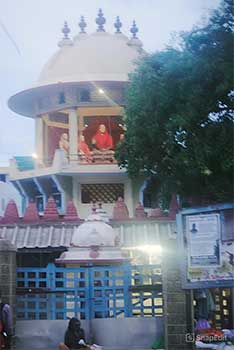 Periyava clarifies that Anjaneya was already located here before anybody else! His idol was not sculptured for this occasion like others here. Rather, He is the original occupant of this sacred place. Acharyal has come to Anjaneya’s place and not the other way around. There is some appropriateness of logic in Acharyal coming to Anjaneya’s place.
Sri Rudram and Anjaneya
Firstly, Periyava cites that in Sri Rudram ‘Sankara’ occurs 13 times. Anjaneya is ‘Rudra Amsam’. He keeps chanting the 13-lettered mantra of “sri rama jaya rama jaya jaya rama.” It is this ‘thriyo-dasa-akshari’ mantra that is the one constantly chanted by Anjaneya. So, it is in the rightness of things that the Rudra avatara Sankara, whose name occurs 13 times in Sri Rudra Ghana Paata, has come to Rudra Amsa Anjaneya, who forever is chanting the 13-syllabled mantra.
Acharyal’s request
Periyava further states that Acharyal himself has requested Anjaneya to stand guard in front perpetually. Periyava refers to the prayer ‘Hanumat Pancharatnam’, on Anjaneya, a ‘Rudra Amsam’ written by Acharyal, an avatara of the very Siva! Acharyal, with extreme humbleness, is praying to Anjaneya, ‘purato mama paatu hanumato moortihi’.
The meaning is as under: - ' mama-to me; purato-in front of; hanumato moortihi-in the form of Anjaneya swami; (may) paatu-shine!’ Acharyal himself had requested that Anjaneya’s form should be effulgent in his immediate front. That is the logic of Hanuman being there in front of Sri Sankara Mandapam, in Rameswaram!
Sri Anjaneya at Sri Sankara Mandapam
 In Rameshwaram, at Kanchi Mutt, Sri Sankara Mandapam is at the center, between Saraswathi Mahal and Sri Anjaneya Temple. To ensure that Anjaneya is relegated to the background, the rest of the temple has been constructed behind Him.
The Sri Anjaneya of this kshetra is depicted with one hand raised and fingers outstretched. This gesture is not only the ‘abhaya hasta’, but also a signal to stop. There is a trijunction of two seas and an ocean in front of Him. He is holding his hand aloft, as though telling the waters of the ocean to halt in their tracks and not come forward any further. Accordingly, the King of the Oceans has abided by Sri Anjaneya’s orders for tens of thousands of years. Thus, Anjaneya’s standing guard in front of this revered location is the best for all of us.
Conclusion by Sri Maha Periyava
Start and End are one. Origin and Culmination are one. The ultimate truth we seek often leads us back to the self, the "I," which is the first thought of all search. This is Advaita. Therefore, Anjaneya Swami, who should come at the end, comes before the Guru, who comes here first, is an explanation of Advaita. ``Dasoham'' (I am enslaved) is said to Sri Ramachandramurthy from being a Dasan, who attains the Advaita essence and conquers the highest pinnacle of oneness with the supreme. So, He is the start of the beginning and end of the finish!
Bound by the raised hand of Anjaneya Swami, Samudram stands subdued. We are languishing in the ocean of samsara. Our mind is wavering incessantly, like the waves of the ocean. Anjaneya Swami is a Manojayan, a conqueror of all the senses. He is said to be "Jidendriyam Budhimadam Varishtam." If we visualize and meditate on Him standing with his hands raised, He will not only give us protection but also calm the ocean of our samsara, the turbulent waves of the mind, and give us happiness and peace.
Readers may kindly see the original article from -Deivathin Kural in Tamil script as told by Sri Maha Periyava
Location of the temple: "Sri Hanuman sannidhi, Sri Kanchi Sankara Mutt, Rameswaram"
Experience
OTHER INTERESTING TEMPLES
SRI HANUMAN THINKS DIFFERENTLY, THINKS FAST
THINKS AHEAD AND ACTS FOR SURE
Ed [December 2025]